Educational briefing / 01 / Relative motion
Motion changes a frequency
A radio source can keep transmitting at a steady frequency while a moving receiver observes a shift. The changing separation is the key.
General technology reading, separate from the company's activities.
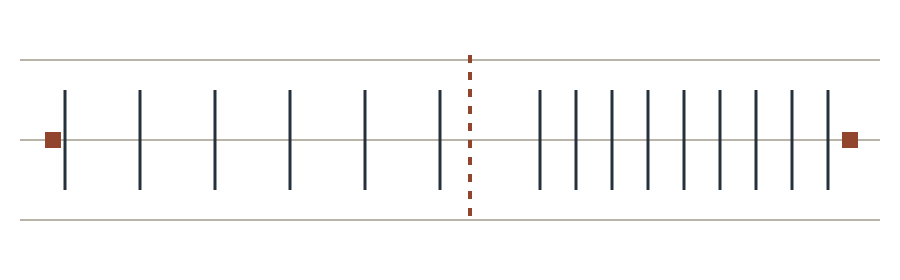
The arriving rhythm
Frequency describes how many wave cycles pass a point each second. If a source and receiver move toward one another, the receiver encounters cycles at a higher rate than it would with no relative motion along their line of sight. Moving apart produces the opposite effect. This change in observed frequency is called Doppler shift.
The shift belongs to the relationship between source and receiver. It does not require the transmitter to deliberately change its setting. That distinction helps separate a change caused by motion from a change that was intentionally placed in the signal.
Which part of motion counts?
The relevant speed is the part that brings the source and receiver closer together or farther apart: radial speed. An object moving quickly across the line of sight may have little radial speed at a particular instant. A frequency shift therefore cannot, by itself, tell you the complete direction and speed of an object.
Consider a hypothetical radio beacon passing a stationary receiver. Its path stays straight, but its motion toward the receiver changes as it passes. Interpreting the observed frequency requires that geometry. The beacon's speed alone does not explain the whole pattern.
A shift needs a reference
To recognize a shift, a receiver needs a frequency reference. Uncertainty in that reference can complicate the interpretation. A detected difference should be considered alongside the expected transmitted frequency and the measurement conditions.
A reflected radar signal also requires careful accounting: it travels to a target and returns. For a simple radar with the transmitter and receiver together, the shift includes both legs of that journey. A one-way communication link and a reflected radar path should not be treated as interchangeable examples.
The practical reading question is: what exactly does this observation represent? Frequency change concerns motion along a path. Travel time concerns how long a journey takes. They can contribute different information, even when they are measured in the same system.
Does a Doppler shift tell you the distance?
Not on its own. A frequency difference describes a rate-related effect. Determining distance requires other information, such as travel time or an independently known geometry. Keep the quantity measured separate from the quantity you want to infer.