Educational briefing / 03 / Propagation
A signal spreads as it travels
Even an unobstructed radio path has a distance-related loss. Understanding that loss starts with geometry rather than an obstacle.
General technology reading, separate from the company's activities.
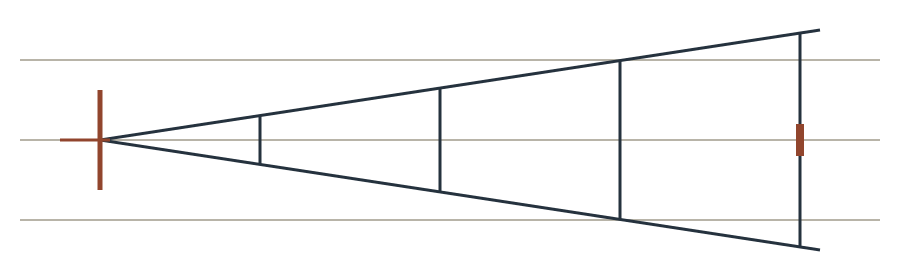
More space to cross
As radiated energy travels away from a source, it can spread over a growing area. A receiver intercepts only part of that distribution. In an ideal free-space setting, moving farther away reduces the power available to a given receiving arrangement.
This geometric spreading is different from energy being absorbed by a wall. It occurs even in the idealized absence of obstacles. Free-space path loss gives a reference for discussing that effect under defined assumptions.
A hypothetical comparison can hold the frequency and antenna gains constant while increasing separation. The predicted loss rises with distance. The useful insight is the controlled comparison: changing several conditions at once would make the result harder to explain.
What the model holds fixed
The usual free-space loss expression depends on distance and wavelength. Wavelength is connected to frequency through propagation speed. Comparisons across frequencies must therefore state the reference conditions, including what is assumed about the antennas.
The standard expression also assumes a far-field situation. Close to an antenna, the field can behave in ways that this simple model does not represent. A formula should be used within the conditions that make its interpretation meaningful.
For a reflected path, the journey includes an outward and a return leg. That is different from a one-way link between two stations. The full reflected-signal calculation also involves the target, rather than simply treating a reflection as another receiving antenna.
A reference is not a guarantee
A real path may include obstructions, reflections, atmospheric effects and changing alignment. An ideal free-space calculation does not automatically include those conditions. It is a starting reference, not a promise that communication will work at a particular location.
Read a predicted loss together with its assumptions. Ask whether the path is one-way, whether distance and wavelength use consistent units, and whether the antenna conditions match the comparison. These checks help expose differences between examples that otherwise look similar.
Motion, direction and distance describe different parts of the same connection. A frequency shift does not replace a power calculation, and a directional antenna does not remove propagation loss. Keeping those ideas distinct makes it easier to connect them carefully.
Does free space mean zero loss?
No. The absence of obstacles does not stop a wave from spreading. Free-space loss describes a geometric relationship under idealized conditions. Additional effects on a real path require additional consideration.